
Analysis of the Fishing Accessories and Fishing Lures Market
Hello everyone, I’m Frederick Ward. As a long-time industry professional closely monitoring the fishing tackle market, I will share the key highlights regarding the 2026 wholesale market for fishing accessories and the global market for fishing lures.
Q: What are the core trends? A: Eco-friendliness, smart technology, and regulatory compliance are the key factors.
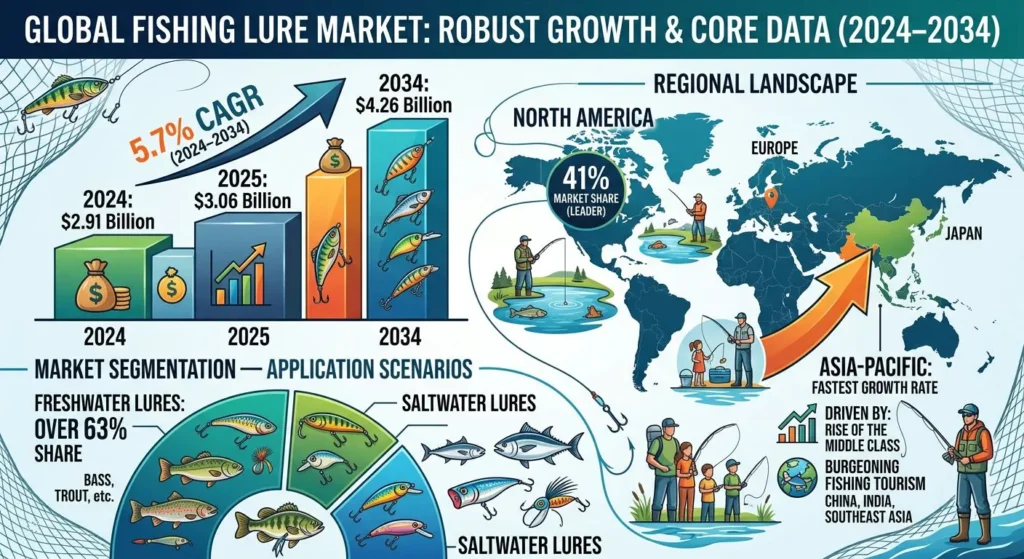
Q: What is the market size for fishing lures? A: It reached $2.91 billion in 2024 and is projected to grow to $4.26 billion by 2034.
Q: What is the status of the North American fishing lures market? A: It accounts for 41% of the global market, making it a core consumption hub.
Part I: The 2026 Global Fishing Accessories and Fishing Lures Wholesale Landscape—Trends, Categories, and a Comprehensive Operational Guide
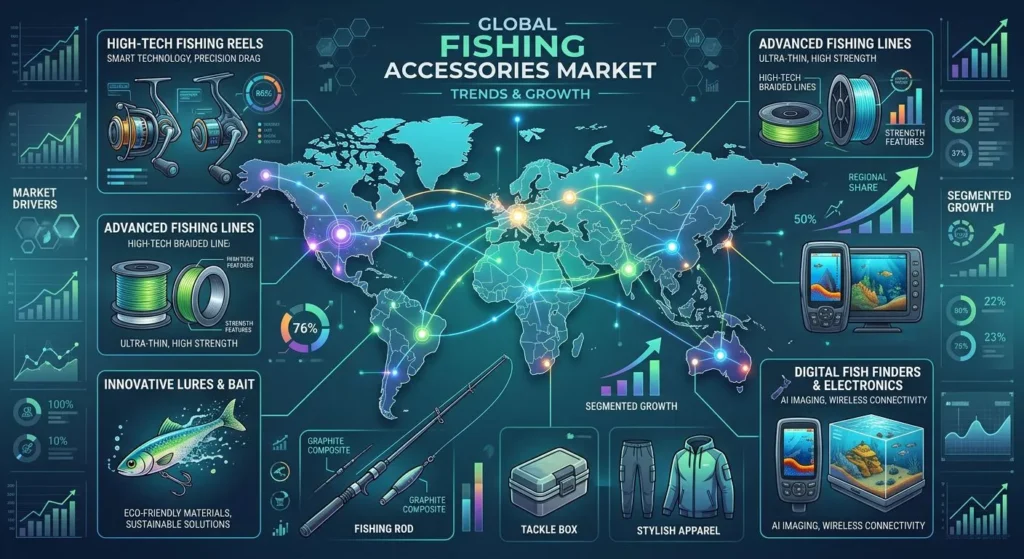
In 2026, the global wholesale market for fishing accessories is entering a period of rapid expansion. Driven by the dual forces of recreational and commercial fishing, the industry landscape is being reshaped by trends toward eco-friendliness, smart technology, and digitalization. These represent the core shifts I have identified through my long-term observations—trends that are bringing brand-new growth opportunities and operational directions to the wholesale sector I focus on.
I. Core Fishing Lures Market Trends: Growth Drivers and Key Directions
- [Continuous Market Expansion] Global demand for fishing accessories is surging, with the Asia-Pacific, North America, and Europe emerging as key growth regions. Based on my observations, increased participation in recreational fishing and the expansion of commercial fishing fleets are the primary drivers sustaining this robust growth trajectory.
- [Eco-friendliness Becomes a Core Procurement Standard] Biodegradable tackle, accessories made from recycled plastics, and eco-friendly packaging are becoming mainstream requirements. I have noted that environmental regulations in various countries are driving the widespread adoption of lead-free and biodegradable products; consequently, maintaining a “green supply chain” has become a core competitive advantage for wholesalers.
- [Full Penetration of Smart Equipment] Smart products—such as Bluetooth bite alarms, digital fish finders, and IoT-enabled tackle boxes—are gradually becoming mainstream. Market feedback I have gathered indicates that technology-driven accessories are particularly appealing to younger anglers and professional fishing fleets, while also offering significant potential for premium pricing.
- [Digital Procurement Becomes the Norm] B2B online platforms have streamlined procurement processes, while cloud-based inventory management and automated order processing have boosted operational efficiency. I believe that online channels effectively enable wholesalers to expand their global client base and reduce operational costs.
- [Heightened Compliance Requirements] Regulatory oversight regarding national fishing quotas, mesh sizes, and fishing tackle materials is becoming increasingly strict across various countries. Based on my understanding of the industry, there is a surging demand for specialized fishing tackle that complies with specific regional standards; consequently, the ability to ensure regulatory compliance has now become a mandatory entry threshold for wholesalers.
II. Core Fishing Accessories and Fishing Lures Categories: Must-Stock Best-Sellers and Innovation Trends
- Terminal Tackle (Core Essentials)
Fish hooks, sinkers, swivels, and leader lines constitute the fundamental essentials of the market. Drawing upon my years of fishing lures industry experience, corrosion-resistant hooks, eco-friendly sinkers, and circle hooks are currently the top-selling items. These products are versatile enough for use in both saltwater and freshwater environments, and buyers increasingly favor bulk packaging options that are environmentally friendly.
- Fishing Lines and Leaders
Nylon lines, fluorocarbon lines, and braided lines currently dominate the market, effectively dividing it into three segments. I have observed that fluorocarbon lines capture the high-end market thanks to their advantages in invisibility and abrasion resistance, while braided lines are highly sought after by professional anglers for their superior tensile strength and high sensitivity. Furthermore, products supplied on large spools are best suited to meet the purchasing demands of commercial clients.
- Fishing Nets, Traps, and Cast Nets
Products such as gillnets, trawls, and crab traps are subject to extremely rigorous compliance requirements. There is a steadily growing demand for region-specific, custom-made nets; I would like to remind industry professionals that these products must strictly adhere to local regulations regarding mesh size and material composition—making them a core purchasing category for commercial customers.
- Artificial Fishing Lures, Baits, and Jigs
Soft baits, hard baits, and metal jigs are the fastest-moving fishing lures in the market. My observations indicate that biodegradable lures and scented attractants have emerged as key areas of innovation. Specifically, saltwater lures place a greater emphasis on durability and realistic swimming action, while effective packaging and strong branding can significantly enhance a product’s price premium.
- Storage, Tools, and Safety Accessories
Modular waterproof tackle boxes, multi-functional fishing pliers, non-slip gloves, life jackets, and first-aid kits are considered essential gear. I have noted a rapid surge in demand for waterproof storage solutions specifically designed for kayak fishing—a trend that industry professionals should pay close attention to.
III. Practical Fishing Accessories and Fishing Lures Wholesale Operations: The Complete Journey from Procurement to Profitability
- The Five-Step Method for Efficient Procurement
- Market Positioning: I recommend first clearly defining your target audience—whether commercial fishing fleets, retail stores, or export markets—to precisely align your offerings with regional fishing practices and regulations.
- Supplier Selection: Thoroughly verify supplier qualifications, production capacity, and environmental certifications; request samples for testing. I firmly believe that prioritizing stable supply channels is the bedrock of a successful business operation.
- Negotiation and Terms: Negotiate bulk discounts and payment terms; clearly define logistics terms such as FOB or CIF. Accurately calculate the comprehensive landed cost—this is the key to effective cost control.
- Quality and Compliance Control: Utilize third-party quality inspections to ensure products comply with standards such as EU REACH regulations and regional fisheries laws, thereby avoiding losses caused by compliance issues.
- Inventory and Fulfillment Management: Leverage cloud-based systems to track SKUs, anticipate stocking needs for peak seasons, and balance inventory levels with cash flow—this is central to ensuring operational stability.
- Pricing Strategies and Profit Enhancement
- Cost Accounting: Comprehensively account for costs across the entire value chain—including raw materials, production, logistics, tariffs, and warehousing—ensuring no expense is overlooked.
- Tiered Pricing: Based on market feedback, I have developed a tiered pricing strategy: full price for orders of 100–499 units, a 20% discount for 500–999 units, and discounts of up to 36% (6.4x original price) for orders exceeding 1,000 units. This strategy is highly effective in attracting large-volume orders.
- Premium Pricing Strategies: Introduce custom private-label options and bundled product sets; simultaneously optimize logistics and inventory efficiency to boost net profit margins. This represents a vital pathway to enhancing overall profitability.
- Core Principles for Long-Term Fishing Lures Business Sustainability
Drawing upon my years of industry experience, I advocate for the following core principles: Build a professional brand by focusing on niche segments such as eco-friendly or commercial-grade fishing tackle; establish a B2B e-commerce presence to expand online customer acquisition channels; cultivate strong customer relationships through loyalty programs; diversify your supplier base to mitigate risk; and remain steadfast in your commitment to sustainable sourcing. Only by adhering to these principles can you build enduring long-term competitiveness. In the 2026 wholesale market for fishing accessories, by accurately identifying and capitalizing on three key trends—eco-friendliness, smart technology, and regulatory compliance—and by meticulously managing your supply chain and customer relationships, you can secure a distinct competitive advantage in the global marketplace.
Part II: An In-Depth Analysis of the Global Fishing Lure Market—Size, Landscape, and Key Opportunities in North America
Fishing lures constitute a high-growth segment within the broader fishing tackle market. From 2024 to 2034, the global market is projected to expand steadily, with North America firmly maintaining its dominant position. As a long-time industry practitioner, I believe that technological innovation and eco-friendly advancements are currently driving transformative changes within the sector, while the surging popularity of recreational fishing continues to unlock significant demand potential.
I. Global Market Core Data Of Fishing Accessories and Fishing Lures: Size, Growth Rate, and Landscape
- [Market Size and Growth] In 2024, the global fishing lure market was valued at $2.91 billion; this figure is expected to reach $3.06 billion in 2025 and grow to $4.26 billion by 2034. This represents a Compound Annual Growth Rate (CAGR) of 5.7% for the 2024–2034 period—a growth trajectory that, based on the data at my disposal, appears exceptionally robust.
- [Regional Distribution] North America holds the leading position with a 41% market share, followed closely by Europe and Japan. Notably, my research indicates that the Asia-Pacific region is experiencing the fastest growth rate; countries such as China, India, and those in Southeast Asia are witnessing explosive growth in demand, driven by the rise of the middle class and the burgeoning trend of fishing tourism.
- [Market Segmentation] — Application Scenarios: Freshwater lures account for over 63% of the market share, catering to mainstream target species such as bass and trout; this segment represents the largest demand base—a key conclusion drawn from my market research. — Sales Channels: Specialized fishing tackle shops account for 31% of sales, while online retail channels are experiencing the fastest growth; sporting goods stores continue to maintain a stable market share. — Materials: Plastic and polymer-based materials remain the mainstream choice, offering an optimal balance between cost-effectiveness and design versatility; conversely, metal and wooden lures tend to be positioned toward the premium and high-end segments of the market.
II. Core Drivers and Challenges: The Logic of Fishing Lures Industry Growth
- Growth Drivers
- Popularity of Recreational Fishing: Over 50 million people in the U.S. participate in fishing activities annually. Fishing tournaments and broader outdoor lifestyle trends have driven demand for specialized artificial lures—a factor I identify as the primary growth driver.
- Technological Iteration: Advancements such as 3D printing, UV-reflective coatings, and electronic sensor-equipped lures have significantly enhanced the realism and fish-attracting efficacy of artificial baits, thereby driving product upgrades.
- Environmental Trends: Biodegradable materials and lead-free components have become key priorities in R&D. These innovations align with global environmental regulations and the eco-conscious values of anglers, representing an inevitable direction for the industry’s future development.
- Industry Pain Points
- Regulatory Restrictions: Various countries have banned specific materials or colors of artificial lures to protect endangered fish species. This undoubtedly increases compliance costs for businesses and constitutes what I consider to be a major challenge facing the industry.
- Rampant Counterfeiting: Low-quality counterfeit products account for 15% of the global fishing lures market share, severely damaging brand reputation and product quality while disrupting market order.
- High-End Price Premiums: Specialized electronic fishing lures command unit prices exceeding $50. These high price points limit market penetration within the mass consumer segment, thereby constraining the industry’s further expansion.
III. The North American Market: Global Core Engine and Trends of Fishing Accessories and Fishing Lures
- [Scale and Growth Rate] In 2023, North America accounted for over 30% of the global market share, with a projected Compound Annual Growth Rate (CAGR) of 4.0% from 2023 to 2030. The United States serves as the core consumer market, while Canada and Mexico demonstrate parallel growth. Based on my understanding of the North American market, its pivotal global status is unlikely to be shaken in the short term.
- [Key Market Segments] – Product Categories: Jigs, soft baits, composite lures, spoons, fly fishing lures, spinnerbaits, and crankbaits constitute the core product types, all of which enjoy robust demand within the North American market. – Fishing Environments: Demand for freshwater fishing leads the sector, while the Great Lakes and saltwater fishing segments are experiencing steady growth. – Sales Channels: Specialized fishing tackle shops remain the core distribution channel, complemented by the synergistic development of online retail platforms, sporting goods stores, and modern mass-market retailers, collectively forming a comprehensive and well-integrated distribution ecosystem. 3. [Competitive Landscape] The top five global enterprises collectively hold a 25% market share. Rapala VMC, Shimano, Globeride (Daiwa), and Pure Fishing stand as the industry leaders. In my observation, these companies lead the market by leveraging comprehensive product portfolios and robust distribution channels, while regional brands focus on localization to suit specific local needs, and DTC brands have successfully broken through by capitalizing on online channels.
IV. Future Fishing Accessories and Fishing Lures Opportunities: Key Strategic Directions for the Sector
- [Mining Emerging Markets] Focus on the Asia-Pacific, South America, and the Middle East & Africa regions. Strategically position cost-effective fishing lures tailored to tropical fish species and the demands of recreational fishing to capture growth in these incremental markets—this is what I consider to be the area with the greatest potential for future expansion.
- [Product Innovation Breakthroughs] Deepen R&D into biodegradable materials, smart electronic fishing lures, and species-specific baits. By creating differentiated products, companies can enhance their pricing power and break free from the constraints of homogenized competition.
- [Channel Optimization and Upgrading] Strengthen online B2C and B2B footprints, integrating subscription models and AI-driven recommendation systems. Simultaneously, cultivate a strong presence in specialized brick-and-mortar stores to elevate the customer experience and establish service-based barriers to entry, thereby achieving synergistic growth between online and offline channels.
- [Prioritizing Compliance and Quality] Strictly adhere to environmental and fisheries regulations, establish a comprehensive quality inspection system, combat counterfeit products, and safeguard brand reputation—these pillars constitute the fundamental bedrock for a company’s long-term sustainable development.
In my view, the Fishing Accessories and Fishing Lures market—bolstered by the boom in recreational fishing—demonstrates strong certainty for long-term growth. With a stable foundation in the North American market and immense potential in emerging markets, companies that prioritize innovation, regulatory compliance, and channel optimization are well-positioned to seize the golden opportunities within this industry.
If you need customized services from a lure factory/lure manufacturer, don’t hesitate to get in touch with us and we will provide you with the most professional service.
Thanks.
Frederick Ward